
Agentic AI Company: Definition, Architecture & Providers
Key Facts
- [
- "Agentic AI is software that decides how to complete a task, uses tools, takes actions, and adapts without a human prescribing every step per market analysis",
- "A chatbot that retrieves a customer's order status is not an agent; agents own the outcome of a decision, close the loop, and move on per documented case studies",
- "Roughly 80% of enterprise data is unstructured, and RPA alone can't reliably process it per Automation Anywhere's analysis",
- "Only 2% of organizations have deployed AI agents at scale per Capgemini data cited in Moveworks' governance guide",
- "Gartner predicts more than 40% of agentic AI projects will be canceled by the end of 2027 per Gartner analysis",
- "Klarna's AI assistant handled ~2.3 million conversations in its first month, two-thirds of all chats, with response times dropping from 11 minutes to under 2 minutes per case-study roundup",
- "Agentic AI is projected to manage 68% of all customer service and support interactions with technology vendors by 2028 per market forecasts"
- ]
What Is an Agentic AI Company? (And What It Isn't)
Most vendors now slap the word "agentic" on their pricing page. That makes it hard to tell who's actually building autonomous AI agents and who's reselling a chatbot with better marketing. The difference matters: it determines whether you get an outcome or a conversation.
Here's the working definition. An agentic AI company builds software that decides how to complete a task, uses tools, takes actions, and adapts without a human prescribing every step. Anthropic's framing is the one most practitioners converge on: agents are systems in which an LLM dynamically directs its own processes and tool use, per this market analysis.
The line between agentic and non-agentic comes down to outcome ownership. As one production-deployment roundup puts it bluntly: "A chatbot that retrieves a customer's order status is not an agent." The deployments generating real returns use agents that own the outcome of a decision, close the loop, and move on, per documented case studies. A chatbot answers. An agent finishes.
RPA vendors are a different story. Automation Anywhere frames the split as muscle versus brain: RPA is deterministic, rules-based execution, while agentic AI supplies reasoning, multi-step planning, and adaptive decisions over unstructured inputs. Roughly 80% of enterprise data is unstructured, and RPA alone can't reliably process it. Notably, many enterprises don't rip out RPA; they wrap existing scripts as API endpoints inside the agent's tool catalog, per Automation Anywhere's own analysis.
So where does a given agentic AI provider sit on the autonomy spectrum? There's no standard scale, so we'll synthesize one from the three established oversight models (human-in-the-loop, human-on-the-loop, human-out-of-the-loop) plus escalation-threshold design. Think of it as five levels:
- Assisted: the AI suggests, the human does everything.
- Supervised: the AI acts, a human approves each action before it executes.
- Delegated: the AI acts and a human monitors, intervening when needed.
- Autonomous: the AI runs within pre-set limits, escalating only outside confidence thresholds.
- Self-improving: the agent refines its own workflows based on outcomes over time.
Most "agentic" products today sit at level one or two. That's fine, but call it what it is.
The market numbers confirm the confusion. Narrow 2025 estimates for direct agentic software converge at $6.76B to $7.29B, while Gartner's $29.2B figure covers agents plus assistants combined, a roughly 3x definitional spread depending on what gets counted. And adoption remains shallow: only 2% of organizations have deployed agents at scale, per Capgemini data cited in Moveworks' governance guide.
That gap between spend and scaled deployment is exactly where firms like Agents by AIQ operate: taking a business from "exploring" to a governed, working agent that owns a real outcome.
Agentic AI Architecture: The Five Layers That Make It Work
Agentic AI has moved beyond the chatbot label to become software that decides how to complete a task, uses tools, takes actions, and adapts without a human prescribing every step. This outcome-ownership distinction separates an agentic AI company from a traditional RPA vendor or conversational assistant, and it is the architecture, more than the model, that determines whether a deployment succeeds at scale.
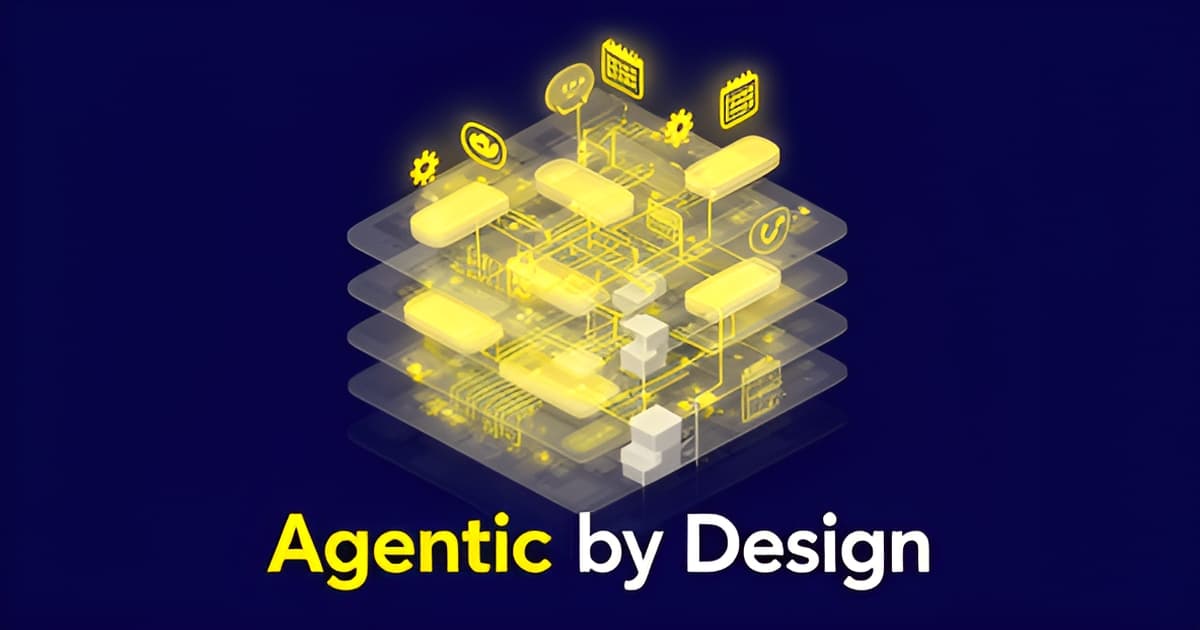
The reference architecture rests on five interlocking layers. At the top, a planner perceive the current state, reason through options, select appropriate tools, and enter an adapt loop based on outcomes; below that, the tool and API layer exposes functions via standardized protocols like Model Context Protocol (MCP) and Agent-to-Agent (A2A) communication, allowing the system to interact with external data and services. Memory layer stores conversation history and contextual state so the agent can maintain coherence across sessions, while guardrails enforce compliance, security, and risk thresholds before any action executes. Finally, an evaluation loop continuously measures performance against key metrics, feeding results back into the planner to refine future decisions. This layered structure is why industry analysts note that production agents require memory, tools, planning, orchestration, and the model itself to function reliably in enterprise environments.
Multi-agent systems have become the norm over single-agent designs because real-world workflows rarely align with a single linear path. As Info-Tech’s Martin Bufi has observed, single-agent architectures rarely succeed in practice, and deployments relying on multiple coordinated agents working across steps in a workflow see higher success rates. These systems have evolved from simple, single-agent solutions to chains, to graphs and multi-agent systems (MAS), where specialized agents hand off tasks based on capability rather than forcing one model to handle every function. This shift is particularly evident in customer service, where agentic AI is projected to manage 68% of all customer service and support interactions with technology vendors by 2028, according to market forecasts.
Human oversight is a non-negotiable architectural component, structured through three models tied to risk tolerance. Human-in-the-loop requires a human to approve an action before it executes, suitable for high-stakes decisions. Human-on-the-loop allows the AI to act while a human monitors output, appropriate for moderate-risk tasks. Human-out-of-the-loop runs the agent within pre-set limits without real-time human intervention, reserved for low-risk, well-defined processes. The EU AI Act Article 14 mandates human oversight for high-risk AI systems, and governance platforms now embed these models directly into the orchestration layer to ensure compliance without slowing velocity.
Market data underscores both the opportunity and the risk of premature deployment. While narrow 2025 estimates for direct agentic software converge at $6.76B–$7.29B, broader definitions that include assistants reach $29.2B, highlighting the importance of scope when evaluating the market. Gartner predicts more than 40% of agentic AI projects will be canceled by the end of 2027, citing escalating costs, unclear business value, and inadequate risk controls as primary drivers. This cancellation rate is a warning that architecture matters as much as the underlying large language model; without proper memory, tool integration, and governance, agents degrade quickly in production.
Agents by AIQ deploys production-grade agentic AI through a done-for-you model that handles the full architecture stack, from planner logic and tool integration to memory management and guardrails, so owner-operators and small teams can deploy AI receptionists, voice agents, and workflow automators without building the infrastructure themselves. See how Agents by AIQ deploys production-grade agentic AI, book a live demo or start a scoped pilot with our team.
What Production Agentic AI Actually Delivers: 4 Real Deployments
Frameworks are cheap. The only honest test of whether a company is truly agentic is what happens in production, with real users and real money on the line. The four deployments below all passed that test, and the numbers are worth studying because they reveal a pattern.
Klarna's AI assistant handled roughly 2.3 million conversations in its first month, about two-thirds of all chats, doing the equivalent work of 853 full-time agents. Response times dropped from 11 minutes to under 2, repeat contacts fell 25%, and the company reported an estimated $60M in annual profit impact, according to a case-study roundup of production deployments. That's a full workflow owned end to end, not a chatbot fetching order statuses.
Morgan Stanley shows the same shape in knowledge work. Advisor adoption hit 98%, and document discovery jumped from roughly 20% to over 80%, with research synthesis that once took 30+ minutes now completed in seconds. AtlantiCare, meanwhile, saved clinicians 66 minutes per day with 80% provider adoption, and DXC Technology reported up to 80% reductions in SOC ticket acknowledgment and triage times.
- Klarna: response times 11 min → under 2 min; ~$60M annual profit impact
- Morgan Stanley: document discovery from ~20% to over 80% adoption
- AtlantiCare: 66 minutes saved per clinician per day
- DXC: up to 80% reduction in triage times
The pattern behind these wins is consistent: agents that own full workflows, not single steps. As one analysis put it, the deployments generating real returns "are using AI agents that own the outcome of a decision, close the loop, and move on to the next." Info-Tech's Martin Bufi makes the same point from the practitioner side: organizations achieving ROI focus on full workflow improvements rather than isolated task automation, and off-the-shelf agents typically fall short without customization.
One caution before you quote ROI figures in a board deck. You'll see claims floating around of a 171% average return or 74% of projects achieving positive ROI in year one. Those numbers lack visible sourcing, so treat them as unverified. The four deployments above are citable; the aggregates aren't.
This is also why deployment model matters more than vendor logo. A platform license gets you tooling; it doesn't get you an agent that owns a workflow inside your stack, with human-in-the-loop escalation thresholds set to your risk tolerance. Teams like Agents by AIQ build and operate those workflows for businesses that don't have an internal AI engineering function, which is exactly the gap the case studies suggest most organizations still face.
Agentic AI Providers Compared: Who to Build With
The gap between vendor hype and production reality is widening. While the agentic AI market is projected to exceed $16 billion by 2025, industry research confirms that 80% of enterprise data remains unstructured, and only 2% of organizations have deployed AI agents at scale. This chasm explains why off-the-shelf agents typically fall short, requiring deep customization to handle the unstructured workflows that define small and mid-size business operations.
This reality creates a critical inflection point for companies evaluating their AI strategy. The difference between a chatbot and a true agentic system lies in outcome ownership: a chatbot retrieves information, but an agent decides how to complete a task, uses tools, takes actions, and adapts without a human prescribing every step. To evaluate providers effectively, teams need a framework that moves beyond marketing language to structural capabilities.
Understanding where a provider sits on the autonomy spectrum is essential for risk management. The framework ranges from Assisted, where the AI suggests options but a human makes the final call, to Self-Improving, where the system iterates on its own performance. Most production deployments cluster in the Supervised or Delegated tiers, where the AI executes defined tasks within guardrails, and human oversight shifts from approval to exception handling. This structure directly maps to the three governance models identified in enterprise research: human-in-the-loop (approve before action), human-on-the-loop (monitor while AI acts), and human-out-of-the-loop (operate within pre-set limits). Organizations pursuing ROI focus on full workflow improvements rather than isolated task automation, recognizing that agentic systems excel when given clear authority boundaries and integrated memory.
The provider landscape spans specialized platforms, RPA extensions, and hyperscaler ecosystems, each with distinct architectural trade-offs.
| Provider | Autonomy Level | Integration Model | Governance Controls | Deployment Options |
|---|---|---|---|---|
| Agents by AIQ | Delegated / Supervised | Pre-built agents integrated with existing business tools; designed for done-for-you operation without custom code | Human-in-the-loop approval for high-risk actions; voice calls answered on real phone numbers for AI Receptionist-grade capability | Fully managed service; scoped pilots available; business owns all outputs month-to-month |
| Automation Anywhere | Delegated | AI Agent Studio integrates with existing RPA scripts; agents operate in a continuous perceive-reason-select-adapt loop, escalating to humans when decisions fall outside confidence thresholds | AI Governance, Process Reasoning Engine, and Mozart Orchestrator for cross-system coordination; SOC 2 and ISO 27001 certified | On-premise, cloud, or hybrid; enterprise licensing model |
| Hyperscaler Offerings (AWS, Azure, Google) | Assisted to Delegated | SDKs and development kits (e.g., AWS Bedrock, Azure AI Foundry) require custom build; agents embedded into existing product suites (Salesforce Agentforce in Sales Cloud, Microsoft in M365/Dynamics) | Shared responsibility model; enterprise-grade compliance (SOC 2, ISO 27001, FedRAMP); human oversight configuration required by customer | DIY deployment on chosen cloud platform; extensive documentation and model libraries |
A critical differentiator emerging from deployment research is the gap between marketed capabilities and production performance. Info-Tech’s Martin Bufi states that off-the-shelf agents "typically fall short" and require code-driven customization; organizations achieving ROI focus on full workflow improvements rather than isolated task automation. This finding serves as the natural bridge to specialized deployment models. Agents by AIQ addresses this exact friction point by offering a done-for-you service model: the team designs, builds, connects, and runs production-grade agents integrated with the tools the business already uses. Unlike DIY toolkits or AI wrappers, AIQ Labs operates the agents so the client owns the outcomes, month-to-month, the client owns everything, and there are no long-term contracts locking value hostage.
Concrete case studies demonstrate what governed deployment looks like at scale. Klarna reported that in the first month, AI agents handled ~2.3M conversations, two-thirds of chats, with equivalent work of 853 full-time agents; response times dropped from 11 minutes to under 2 minutes, and repeat contacts decreased by 25%, representing a ~$60M annual profit impact. Morgan Stanley saw 98% advisor adoption with document discovery rising from ~20% to over 80%, and research synthesis that previously took 30+ minutes now completes in seconds. AtlantiCare achieved 80% provider adoption, a 42% documentation time reduction, and 66 minutes saved per clinician per day. These outcomes share a common thread: success comes from systems that own the end-to-end outcome, not partial automations that require constant human rescue.
For owner-operators and small teams in trades, legal, healthcare, insurance, real estate, ecommerce, and professional services who are losing missed calls, slow lead follow-up, and manual busywork, the question is no longer whether to deploy agentic AI, but how to deploy it with governance that scales. The provider comparison above offers a starting point for that evaluation.
See how Agents by AIQ deploys production-grade agentic AI, book a live demo or start a scoped pilot with our team.
How to Choose and Start With an Agentic AI Company
Most agentic AI projects don't fail because the technology is weak. They fail because teams pick the wrong vendor for their situation or wait too long to ship anything. Gartner predicts more than 40% of agentic AI projects will be canceled by the end of 2027, usually due to escalating costs, unclear business value, or inadequate risk controls. You can avoid that fate with a short evaluation pass before you commit.
Start with a four-point checklist. First, autonomy level: ask where the agent sits on the oversight spectrum, whether that's human-in-the-loop approval, human-on-the-loop monitoring, or fully autonomous execution within limits. A governance guide from Moveworks frames these as three distinct models tied to risk, and any serious agentic AI provider should be able to tell you which one a given workflow uses and why. Second, tool integration: the agent needs to connect to your CRM, phone system, and calendars, not live in a demo sandbox. Third, governance controls: confidence thresholds, escalation paths, and audit logs. Fourth, deployment speed: how many weeks from kickoff to a working agent on real data.
- Autonomy level: supervised, delegated, or autonomous, matched to the risk of each task
- Tool integration: native connections to the systems you already run
- Governance controls: escalation thresholds, human approval gates, logging
- Deployment speed: a concrete timeline, not a discovery phase with no end
Then apply the 80/20 rule. PromptCare's deployment philosophy, as documented in a TechTarget case-study roundup, is to ship at roughly 80% completeness and refine the remaining 20% through iteration. That matches how the successful deployments actually work: Klarna's agent handled about 2.3 million conversations in its first month and got better from there. Waiting for perfection before launch is how projects end up in the canceled 40%.
One more thing worth knowing: off-the-shelf agents "typically fall short," in the words of Info-Tech's Martin Bufi. The organizations getting real returns customize agents to own a full workflow rather than a single task. That's why a scoped starting point beats a platform purchase. Pick one high-frequency, measurable job: answering calls on a real business line so missed calls stop leaking revenue, or following up with inbound leads within minutes instead of hours. Customer service is the largest application segment at 32.1% of 2025 market share precisely because these workflows are easy to measure and quick to prove.
Agents by AIQ works exactly this way: a scoped, done-for-you pilot on one workflow, integrated with your existing tools, with you owning everything that gets built. See how Agents by AIQ deploys production-grade agentic AI. Book a live demo or start a scoped pilot with our team.
Frequently Asked Questions
What is an agentic AI company, and how is it different from a chatbot vendor?
Is agentic AI the same thing as RPA?
How big is the agentic AI market, and how many companies have actually deployed agents?
What does agentic AI architecture actually consist of?
Do agentic AI deployments actually deliver measurable ROI?
Why do so many agentic AI projects fail, and how do I avoid picking the wrong vendor?
The Bottom Line: Outcomes, Not Conversations
The line between an agentic AI company and a chatbot vendor comes down to one thing: outcome ownership. A chatbot answers; an agent finishes the job, closes the loop, and moves on. That's what the production evidence shows, Klarna's agents handled 2.3 million conversations in a month, Morgan Stanley lifted document discovery from ~20% to over 80%, and AtlantiCare gave clinicians back 66 minutes a day. The architecture matters as much as the model: planner, tools, memory, guardrails, and an evaluation loop, governed by the right level of human oversight for the risk. And with only 2% of organizations having deployed agents at scale, the advantage still goes to teams that start now, scoped and small, rather than waiting for perfect. Pick one measurable workflow, a phone line that stops missing calls, leads followed up in minutes instead of hours, and ship at 80%. Agents by AIQ builds and operates exactly those done-for-you agents, integrated with the tools you already use, month-to-month with you owning everything. See how Agents by AIQ deploys production-grade agentic AI, book a live demo or start a scoped pilot with our team.