
Agentic AI vs AI Agents: Key Differences Explained
Key Facts
- OpenAI defines agentic AI as systems pursuing complex goals with limited direct supervision.
- IBM defines an AI agent as a single system that autonomously designs workflows and utilizes available tools.
- Multi-agent systems held 66.4% of the agentic AI market in 2024, making orchestration the main investment target.
- Only 7% of organizations reached the Operationalizing stage with significant ROI despite 79% adoption.
- Just 2% of enterprises use identity security tools built for AI agents according to market research.
- Agent quality must be measured through actions, not only responses, per industry analysis.
- Singapore published a dedicated Model AI Governance Framework for Agentic AI, signaling regulatory distinction from general AI.
Why Everyone Confuses Agentic AI and AI Agents (And Why It Matters)
Search any vendor's documentation and you'll find "agentic AI" and "AI agents" used as if they mean the same thing. Even IBM, one of the most careful definers in the field, uses the two terms largely interchangeably, treating "agentic" as an adjective rather than a distinct category in its AI agents explainer. That looseness muddies buying decisions, architecture planning, and vendor conversations.
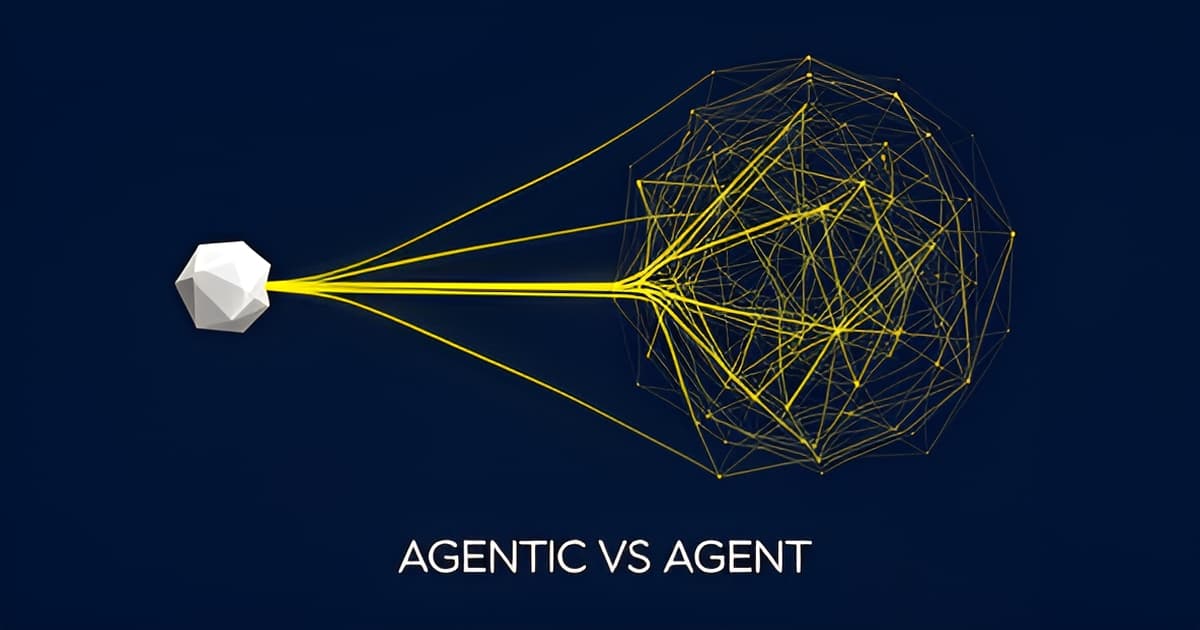
The clearest way to resolve the agentic ai vs ai agents question is a framing we'll use throughout this article: paradigm versus artifact. An AI agent is one autonomous actor. Agentic AI is the architectural paradigm in which goal-directed agents are orchestrated to pursue outcomes. Start with the sourced definitions and the distinction snaps into focus.
What is agentic AI?
OpenAI, in its white paper on governing agentic AI systems, defines the category this way:
Agentic AI systems, AI systems that can pursue complex goals with limited direct supervision, are likely to be broadly useful if we can integrate them responsibly into our society.
Precedence Research adds the behavioral markers: autonomous decision-making, goal-directed behavior, and long-term planning, with systems that "proactively initiate actions" rather than merely react to inputs.
What are AI agents?
IBM's definition centers on the individual actor:
An artificial intelligence (AI) agent refers to a system or program that is capable of autonomously performing tasks on behalf of a user or another system by designing its workflow and utilizing available tools.
IBM then supplies the composition layer: multiagent systems are "multiple AI agents working collectively," and agentic architecture is the structure that shapes how those agents are automated and coordinated within an agentic AI system. One is the brick. The other is the building.
Why does this matter beyond vocabulary? Because the confusion has real costs:
- Maturity is low. Only 7% of organizations have reached the "Operationalizing" stage of agentic AI with significant ROI, per market research, so most buyers are planning architectures they don't yet fully understand.
- Multi-agent systems already hold 66.4% of the agentic AI market, which means orchestration, not single agents, is where most investment lands.
- Governance is going agentic-specific. Singapore has published a dedicated Model AI Governance Framework for Agentic AI, and OpenAI treats agentic systems as a distinct governance class with distinct risks.
If you're evaluating vendors, the difference determines what you're actually buying: a single agent that answers phones or follows up leads, or an orchestrated system where agents hand work to each other. Teams like Agents by AIQ spend most of their scoping conversations untangling exactly this. The buyer who says "we need an agent" and the buyer who says "we need an agentic system" get very different architectures, budgets, and governance requirements. Getting the words right is the first step to getting the build right.
What Is Agentic AI vs What Are AI Agents: The Definitions
Ask five vendors what "agentic AI" means and you'll get five slightly different answers. The confusion is real, and it matters, because the two terms describe different things: one is a category of software you can buy or build, the other is an architectural approach to how that software operates.
Let's start with the definitions that carry the most weight.
What is agentic AI? OpenAI, in its white paper on governing agentic systems, defines agentic AI as "AI systems that can pursue complex goals with limited direct supervision." Precedence Research adds the behavioral detail: these systems exhibit "autonomous decision-making capabilities, goal-directed behaviour, and long-term planning like human agents." The key contrast they draw is with traditional AI, which reacts to specific inputs. Agentic AI proactively initiates actions, adapts to new environments, and operates with a degree of self-governance.
What are AI agents? IBM defines an AI agent as "a system or program that is capable of autonomously performing tasks on behalf of a user or another system by designing its workflow and utilizing available tools." An agent doesn't just answer questions. It plans, makes decisions, uses tools, retains context across interactions, and completes multi-step tasks, often operating beyond the constraints of its training data by connecting to external systems through APIs.
So what's the actual difference between agentic AI and AI agents? The clearest defensible reading, drawn from how these sources use the terms, is paradigm versus artifact:
- An AI agent is a single autonomous software actor: one system that perceives, reasons, and acts on your behalf.
- Agentic AI is the broader architectural paradigm: goal-directed, self-orchestrating systems in which agents operate.
- IBM's own definitions support this layering. It describes multiagent systems as "multiple AI agents working collectively," and separately defines "agentic architecture" as the structure and design that shapes how workflows are automated within an agentic AI system.
- In practice, multiple AI agents, orchestrated together, compose an agentic AI system. The agents are the workers; agentic AI is the operating model.
IBM also classifies AI agents into five types, which is useful vocabulary when you're scoping what you actually need: simple reflex agents, model-based reflex agents, goal-based agents, utility-based agents, and learning agents. Most business-grade agents today sit somewhere between goal-based and learning agents, using memory and tool access to handle real workflows rather than single prompts.
One honest caveat: the industry hasn't settled this terminology. IBM's own materials use "AI agents" and "agentic AI" somewhat interchangeably, treating "agentic" as an adjective rather than a distinct category. Market research firms treat "agentic AI" as a market category (one valued at roughly $5.2 billion in 2024, per market.us). So treat the paradigm-versus-artifact distinction as the clearest synthesis of expert definitions, not as settled industry law.
That said, the distinction is useful when you're making decisions. If someone pitches you "an agent," you should ask what it can actually do autonomously: which tools it can use, what authority it has to act, and whether it persists context between tasks. If someone pitches you "agentic AI," you should ask how multiple agents or steps get orchestrated, who supervises the system, and how its actions are verified. As MarketsandMarkets puts it in its agentic AI market analysis, agent quality "must be measured through actions, not only responses." That's a good test for both definitions.
At Agents by AIQ, this distinction shapes how we scope every build: first we define what each individual agent should autonomously handle (answering calls, following up on leads, chasing appointments), then we design how those agents work together as a system. Definitions are the starting point. What matters is what the system does when you're not watching it.
Agentic AI vs AI Agents Comparison: Side-by-Side Table and Diagram
Definitions only get you so far. The real test is putting AI agents and agentic AI side by side and seeing where they diverge, because the differences show up in architecture, autonomy, and how you measure whether the system actually worked.
The clearest way to frame it: an AI agent is a single autonomous actor that performs tasks on your behalf, while agentic AI is the architectural paradigm in which goal-directed agents are orchestrated to pursue complex outcomes with limited supervision. IBM's own materials use the terms somewhat interchangeably, so treat this as the most defensible reading of the research rather than a settled industry standard.
Here's the side-by-side comparison:
| Dimension | AI Agents | Agentic AI |
|---|---|---|
| Scope | A single autonomous software actor completing defined tasks | The composed system and paradigm: multiple agents pursuing complex goals together |
| Autonomy | Autonomous within its assigned task | High autonomy with minimal human oversight; proactive rather than reactive |
| Reasoning | Plans and makes decisions for its own workflow | System-level reasoning, long-term planning, adaptation to new environments |
| Tool use | Uses available tools and APIs to act beyond training data | Connectivity platforms give agents the reach to convert reasoning into action |
| Memory | Retains context across interactions | Persistent memory turns stateless agents into durable, stateful workers |
| Orchestration | None required; the agent is the unit | Core layer: coordinates specialized agent roles into one workflow |
| Authority to act | Delegated for specific tasks | Delegated broadly, which is why governance becomes mandatory |
| Examples | A support agent resolving tickets, an SDR agent handling follow-up | A multi-agent system running an entire service journey end to end |
One row deserves extra weight: how you evaluate quality. As market analysis puts it, agent quality "must be measured through actions, not only responses." A chatbot is judged on what it says. An agentic system is judged on what it did, and whether that work can be verified.
The composition is easiest to see as a layered diagram. Picture it like this:
- Agent layer: individual AI agents, each with a specialized role, such as intake, research, scheduling, or follow-up
- Orchestration layer: coordinates handoffs, sequencing, and state across agents (frameworks like LangGraph exist specifically for stateful multi-agent systems)
- Memory and context layer: persists information across interactions so the system doesn't restart from zero
- Connectivity layer: integrates the tools, APIs, and data sources agents act through
- Governance layer: guardrails, observability, and access controls, which OpenAI treats as a distinct discipline for systems pursuing goals with limited supervision
This isn't a niche architecture. Multi-agent systems held 66.4% of the agentic AI market in 2024, according to market research, as enterprises decompose complex workflows into specialized agent roles. That said, composition patterns vary in practice. One practitioner ran nine specialized agents with no central orchestrator at all, coordinating through structured handoff documents instead.
The practical takeaway for a small business: you rarely need to reason about the paradigm. You need agents that work, connected to your tools, with someone accountable for the orchestration and governance layers. That's the gap between reading definitions and having a system answer your missed calls, and it's the gap we design for at Agents by AIQ.
Governance: The Layer That Makes Agentic AI Production-Ready
Understanding the difference between agentic AI and AI agents is table stakes. What separates a working demo from a production system is the governance layer wrapped around it, and most organizations don't have one yet.
The signals are easy to miss if you only read definitions. OpenAI published a dedicated white paper on governing agentic AI systems, framing them as systems that "can pursue complex goals with limited direct supervision" and acknowledging both substantial potential and real risks of harm. Singapore went further with a Model AI Governance Framework specifically for Agentic AI. Regulators aren't treating agentic systems as just another chatbot with a fancier name, and neither should you.
The security numbers explain why. According to market research on agentic AI adoption, only 2% of enterprises use identity security tools built for AI agents, while AI agents already make up 22% of non-human accounts and 85% of organizations still rely on legacy identity tools. Meanwhile, 49% of organizations now define high-risk scenarios where autonomous agents lack access, up from 28% a year earlier. The threat surface is growing faster than the tooling.
Governance also explains the maturity gap. The same research shows 79% of US executives report AI agent adoption, but only 7% of organizations have reached the "Operationalizing" stage with significant ROI. Definitions don't get systems into production. Guardrails do. As one practitioner put it, "It said it did the work" is not the same as "the work can be verified" (practitioner discussion on agentic trust).
What a real governance layer covers:
- Identity and access control: treating agents as first-class security principals, not shared API keys.
- Action verification: measuring agent quality through actions taken, not only responses generated.
- Audit trails: logging what each agent did, when, and under what authority.
- Escalation paths: defining high-risk scenarios where agents must stop and hand off to a human.
IBM frames AI agent governance as the processes, standards, and guardrails that keep agentic systems safe and ethical, and industry analysis notes that governance, security, and observability become mandatory as agents receive authority to act. That last phrase matters. The moment an agent can send an email, book an appointment, or modify a record, you're no longer evaluating a language model. You're supervising a worker.
This is why teams like Agents by AIQ treat governance as part of the build, not an afterthought. When we design agents that answer calls or follow up with leads, the question isn't just "can it do the task?" It's "can you prove it did, and can you stop it when it shouldn't?"
Ready to move beyond definitions? See how Agents by AIQ designs and deploys production-grade agentic systems. Book a demo.
From Definitions to Deployment: What This Means for Your Business
Definitions only pay off when they change what you build. The agentic AI vs AI agents distinction maps directly onto scoping decisions: which agent you need, what it's allowed to do, and how many of them have to work together.
Start with the smallest unit. An AI receptionist that answers calls on a real phone number is a single AI agent: one autonomous actor with a job description (answer, qualify, book), tools (your calendar, your CRM), and authority to act within those bounds. It plans its own workflow mid-call. It doesn't need a fleet behind it.
Now widen the scope. A lead follow-up sequence where one agent researches the prospect, a second drafts and sends the outreach, and a third books the meeting is where the agentic AI conversation starts. IBM's definition of multiagent systems covers exactly this: multiple AI agents working collectively on behalf of a user. The orchestration layer between them is the agentic architecture.
A practical way to scope an agent build for your business:
- Single agent: one bounded job (phone answering, support triage, appointment setting) with clear tools and a clear stop condition.
- Multi-agent system: a workflow with distinct roles that hand work to each other, like research → outreach → booking.
- Agentic AI system: the full composed setup, including orchestration, shared memory, tool connections, and governance over what each agent may do.
The market data backs the multi-agent direction. Market analysis puts multi-agent systems at 66.4% of the agentic AI market in 2024, and 75% of business leaders expect different agents to handle different problems. You don't need one agent that does everything. You need a few that do their parts well and hand off cleanly.
Adoption is running ahead of maturity, which matters when you plan. The same research finds 79% of US executives report AI agent adoption, yet only 7% have reached the operationalizing stage where agents deliver significant ROI. Most teams stall on integration and data foundations, not on model quality.
That gap is the practical argument for designing the system before deploying it. A support agent that can't escalate to a human, or a receptionist with no guardrails on what it can promise, is a liability. Industry framing puts it plainly: agent quality must be measured through actions, not only responses. Governance and observability become mandatory the moment an agent receives authority to act.
Ready to move beyond definitions? See how Agents by AIQ designs and deploys production-grade agentic systems: AI receptionists that answer calls on a real phone number, lead follow-up agents, and support agents, scoped to your workflow and integrated with the tools you already use. Month-to-month, and you own everything. Book a demo.
Frequently Asked Questions
What is the difference between agentic AI and AI agents?
Are agentic AI and AI agents just different names for the same thing?
How is agentic AI different from a chatbot or generative AI?
Do I need one AI agent or a multi-agent system for my business?
Is agentic AI actually mature enough to deploy in production?
What governance or security concerns come with agentic AI?
The Words Are Settled. Now Build the System.
The agentic AI vs AI agents question comes down to one framing: an AI agent is a single autonomous actor with a job, tools, and authority to act, agentic AI is the architectural paradigm where multiple agents, orchestration, memory, and governance compose into a system pursuing complex goals. Getting that distinction right changes what you buy, how you scope it, and what you demand from vendors. It also explains why so many deployments stall: adoption is broad, but only 7% of organizations have reached the operationalizing stage with significant ROI, per market research, most teams trip on integration and guardrails, not model quality. Your next steps are simple. Name the smallest agent that solves a real problem in your business, define what it's allowed to do and where it must stop, then decide whether the workflow needs more agents behind it. That's exactly how we scope builds at Agents by AIQ: AI receptionists answering calls on a real phone number, lead follow-up, and support agents, integrated with the tools you already use, month-to-month, and you own everything. Ready to move beyond definitions? See how Agents by AIQ designs and deploys production-grade agentic systems. Book a demo.