
Future Trends in AI Automation for Small Business
Key Facts
- State legislatures introduced 260 AI measures in the 2025 session, with 22 passed by late June per Brookings analysis.
- 65% of small business owners worry about compliance costs from a patchwork of state AI laws, up 14 points in a U.S. Chamber survey.
- Fewer than 1 in 3 small business owners feel well prepared to comply with state AI obligations the Chamber survey found.
- In February 2024 the FCC confirmed TCPA telemarketing rules apply to AI-generated voices per compliance guidance.
- 39 states plus DC use one-party consent for call recording, while 11 states require all-party consent per compliance guidance.
- Peer-reviewed research finds small firms are driven by competition but large firms are constrained by regulation in Technological Forecasting and Social Change.
- California's AB 2927 already requires bots to identify themselves in sales and service interactions with residents per compliance guidance.
The Patchwork Problem: State Rules Are Arriving Fast
If you're waiting for Congress to sort out AI rules before you adopt automation, you'll be waiting a long time. There is no federal AI legislation on the books, which means the requirements that actually touch your business are showing up in state bills, agency guidance, and industry-specific rules instead.
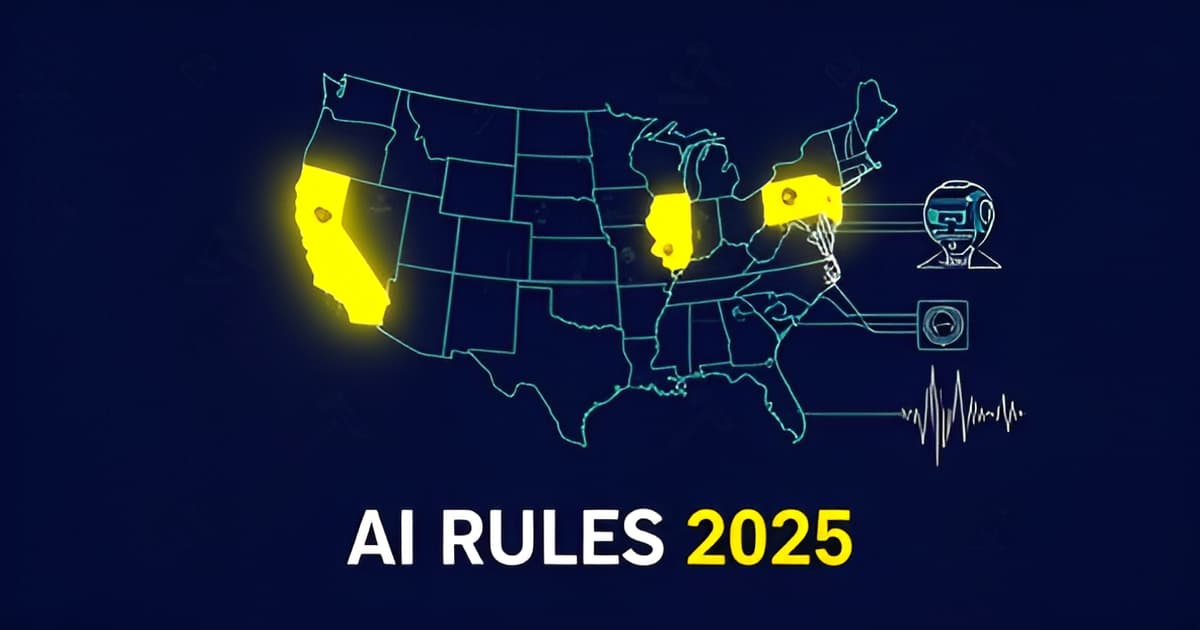
The pace is the story. The Brookings Institution counted 260 state AI measures introduced in the 2025 legislative session alone, with 22 passed as of June 27, according to CFO Dive's analysis. That's not a slow drift toward regulation. That's dozens of legislatures writing rules at once, each with its own definitions and obligations.
Small business owners have noticed. In a U.S. Chamber of Commerce survey, 65% said they worry about compliance and litigation costs from a patchwork of differing state laws, up 14 percentage points from the year before. Fewer than one in three feel well prepared to comply with state AI obligations. Jordan Crenshaw of the Chamber's Technology Engagement Center called it the highest level of concern they've recorded, arguing that policymakers need a single national framework instead of rules that "stifle" small business growth.
What's striking is that the state requirements are converging on a handful of themes. Watch for these as bills move in your state:
- Disclosing to customers when they're interacting with AI rather than a person
- Conducting risk assessments before deploying AI systems
- Explaining how AI affects customer interactions
- Keeping human oversight over systems making consequential decisions
Some of this is already enforceable. California's AB 2927 requires bots to identify themselves when interacting with residents for sales or services, and Illinois restricts AI in video job interviews under its AI Video Interview Act. The trend line is clear: more states will require disclosure, even though no federal law currently does, as compliance guidance for AI receptionists notes.
There's also tension coming from the other direction. The White House AI action plan directs federal agencies to weigh a state's AI regulatory climate when awarding AI funding, and the administration has called for a federal standard that supersedes state laws. Brookings put it plainly: there's "a storm cloud over this progress at the federal level," and it's unclear how that will shape what states do next.
For you, the practical takeaway is simple. Inbound call answering carries far less regulatory risk than outbound AI calling, where TCPA rules require prior express written consent. Disclosure and human escalation paths are cheap to build in now and expensive to retrofit later. That's how we approach agent design at Agents by AIQ: configure agents to identify themselves, route sensitive conversations to a human, and keep records of how the agent is set up. It won't substitute for legal advice, and you should talk to an attorney about high-risk uses like hiring or financial decisions. But businesses that balance adoption with oversight will be better positioned to keep the benefits while the rules keep changing underneath them.
Where Voice AI Carries Real Legal Weight
Of all the AI tools a small business can deploy, voice agents sit squarely in regulated territory. In February 2024, the FCC confirmed that TCPA restrictions on artificial or prerecorded voice apply to AI-generated voices, which means the same telemarketing rules that govern human cold callers now govern your AI agent.
The practical split is simple: outbound AI calls require prior express written consent before dialing a mobile or residential number, while inbound calls carry far less regulatory risk. That's why inbound answering is the natural starting point for most small businesses. When a customer calls you, the TCPA burden largely disappears. The moment your agent starts dialing out, you're into written consent, opt-out mechanisms, and Do Not Call list compliance.
Recording adds a second layer of rules that vary by state. According to a compliance guide for AI receptionists, 39 states plus DC operate on one-party consent, meaning only one person on the call needs to agree to recording. But 11 states, including California, Florida, Illinois, and Washington, require all-party consent. In those states, your agent has to disclose that it's recording, get explicit consent before capturing audio, and allow callers to opt out. An agent configured for a one-party state can get you into trouble the moment it takes a call from an all-party state.
Timing matters too. No AI call should run before 8 AM or after 9 PM in the caller's local time, the same call-window rule that applies under the TCPA. A well-built agent enforces this automatically; a poorly configured one can generate violations at 7 AM.
A few configuration basics worth getting right before launch:
- Outbound AI calling only with documented prior express written consent
- Recording disclosure and consent flows that satisfy all-party consent states
- Call windows enforced against the caller's local time zone
- Clear opt-out handling and call identification on any outbound campaign
The stakes are rising as states pile on. Brookings counted 260 state AI measures introduced in the 2025 legislative session, and disclosure requirements like California's bot disclosure law are spreading. For businesses in healthcare or finance, telecom rules are only the floor; HIPAA and GLBA obligations stack on top.
This is the work we handle when building voice agents at Agents by AIQ: consent logic, recording rules, and call windows configured into the agent itself, so compliance isn't something you remember after the first call goes out. It's worth noting that none of this makes voice AI a legal minefield to avoid. It makes configuration the difference between an agent that saves you hours and one that creates exposure.
Four Obligations State Rules Are Converging On
If you're waiting for one clear federal AI law to plan around, you'll be waiting a while. There isn't one, and states are filling the gap fast: Brookings counted 260 state AI measures introduced in the 2025 legislative session, with 22 passed by late June.
The good news is you don't need to track all 260 bills. When you read them together, state rules are converging on four core obligations, and they're practical enough to prepare for now:
- Disclose AI use to customers. California's AB 2927 already requires bots to identify themselves in sales and service conversations, and Illinois has a comparable rule under its AI Video Interview Act for hiring.
- Run AI risk assessments before deploying systems that touch customers or consequential decisions.
- Explain how AI affects the customer interaction, not just that it's being used.
- Keep a human in the loop on decisions that genuinely matter, like pricing, hiring, or anything with legal weight.
Some of this is already live. Compliance guidance for AI receptionists notes that California's bot disclosure law applies to any AI interacting with California residents for sales or services, and the forecast from most observers is blunt: more states will require disclosure.
Here's the part most small business owners don't expect. Disclosure isn't the friction point they assume it'll be. Vendors observing real deployments report that callers who know they're talking to AI tend to speak more clearly, give information more directly, and show more patience with the system's limits. Transparency sets expectations, and expectations do a lot of the work.
That said, the anxiety is real and growing. A U.S. Chamber of Commerce survey found 65% of small business owners worry about compliance and litigation costs from a patchwork of differing state laws, up 14 percentage points from the 2024 poll. Fewer than 1 in 3 feel well prepared to comply.
The practical move is to treat the four obligations as design requirements rather than legal threats. When Agents by AIQ builds a voice agent or receptionist for a client, disclosure and human escalation paths get configured in from the start, because retrofitting them after a state law passes is far harder than building them in on day one. The businesses that adopt this way won't be scrambling when their state's bill lands.
Sector Rules Still Set the Floor
For businesses in regulated industries, state AI rules are only the starting point. Healthcare, finance, real estate, and legal practices carry layered obligations on top of whatever their state legislature passes, and those sector rules are usually the stricter layer.
The specifics matter. A healthcare practice using an AI receptionist needs a Business Associate Agreement from the AI provider, with the agent limited to non-clinical interactions. Financial services firms need GLBA-aligned encryption, access limits, and opt-out mechanisms. Real estate agents face filters preventing any discussion of protected classes under the Fair Housing Act. And legal practices have to constrain what an agent can say so it never provides legal advice or forms an attorney-client relationship, which would risk unauthorized practice of law.
Layered on top of all that is the state patchwork. Legislators introduced 260 state AI measures in the 2025 session alone, with 22 passed as of late June, according to Brookings Institution analysis. Common requirements are converging around disclosure of AI use, risk assessments, and human oversight of consequential decisions.
Here's the uncomfortable part: small firms are the least equipped to handle this. Peer-reviewed research in Technological Forecasting and Social Change found that small firms are driven by competition while large firms are constrained by regulation. But the same study cautions that small firms have weaker AI readiness, which leaves them disadvantaged when those constraints do land on them. Large firms have compliance departments. You have a Tuesday.
That gap shows up in purchasing decisions too. Compliance certifications like SOC 2, HIPAA, and PCI vary widely by vendor and are often gated behind enterprise pricing tiers, which effectively prices smaller businesses out of the compliant option. If a healthcare provider's AI vendor can't produce a BAA, the guidance is blunt: don't use them for healthcare.
What this means practically:
- Ask any AI vendor for sector-specific compliance documentation before signing, not after.
- Keep agents scoped to non-clinical, non-advisory interactions in healthcare and legal settings.
- Build in human escalation paths for sensitive conversations, since hybrid AI-plus-human models are becoming the standard in regulated industries.
- Remember that you remain responsible for your AI's actions, the same way you're responsible for human employees.
This is why we design agents at Agents by AIQ with sector constraints built in from the start, including disclosure behavior and escalation paths, rather than bolting them on later. Sector rules set the floor. Your agent configuration should be built to meet it.
A Practical Order of Operations for Small Teams
Regulation shouldn't be the reason you delay automation, but it should shape the order in which you deploy it. With 260 state AI measures introduced in the 2025 legislative session and 22 already passed by late June, according to Brookings analysis, small teams need a sequence that front-loads the low-risk work.
Start with inbound call answering. The FCC confirmed in February 2024 that TCPA restrictions on AI-generated voices apply to outbound calls, which require prior express written consent, while inbound calls carry far less regulatory risk. That makes an AI receptionist answering your existing phone line the sensible first deployment, with any outbound calling treated as a later, more heavily governed step.
Second, build disclosure and escalation into agent behavior from day one. California's AB 2927 already requires bots to identify themselves in sales and service interactions, and disclosure is one of four requirements states are converging on, alongside risk assessments, explainability, and human oversight of consequential decisions. Configure agents to say they're AI upfront and to hand off to a human when a call turns sensitive. This isn't just legal hygiene. Caller backlash after discovering they talked to a bot is a documented trust problem, and vendors note that customers who know they're speaking with AI tend to be more direct and more patient.
Third, treat vendor compliance as a purchasing criterion. Ask any provider for SOC 2 Type 2, PCI, and HIPAA documentation, and if you're in healthcare, a signed BAA. The guidance is blunt: if a vendor can't provide a BAA, don't use them for healthcare calls. This matters because compliance access is often gated behind enterprise pricing, with some providers charging a $1,000 HIPAA add-on and others offering SOC 2 only on top tiers. At Agents by AIQ, we build and run done-for-you agents on month-to-month terms with the client owning everything, and part of that scoping conversation is confirming the compliance posture fits your sector, whether that's HIPAA for healthcare, GLBA-aligned controls for finance, or Fair Housing filters for real estate.
Finally, keep watching your state legislature. Fewer than 1 in 3 small business owners feel well prepared to comply with state AI obligations, and 65% worry about compliance costs from a patchwork of differing laws, per a U.S. Chamber survey. Federal policy is in flux too, with the White House pressuring states to loosen rules while legislatures keep passing them. The practical response is ongoing monitoring, not guessing at the end state.
If you want an agent scoped against this sequence, book a call and we'll walk through where your business should start.
Frequently Asked Questions
Is there a federal AI law I need to comply with for my small business?
Can my AI voice agent legally make outbound calls to customers?
Do I have to tell customers they're talking to an AI instead of a person?
What are the rules for recording calls with an AI agent?
I'm in healthcare or finance, can I still use an AI receptionist?
How worried should I be about the patchwork of state AI laws?
Regulation Is Coming Either Way, Get Your Agent Ready First
The regulatory picture for AI automation is messy and getting messier: no federal law exists, 260 state AI measures were introduced in the 2025 session alone, and fewer than 1 in 3 small business owners feel prepared to comply. But the response isn't paralysis, it's sequencing. Start with inbound call answering, where TCPA risk is minimal. Build in disclosure and human escalation from day one, because retrofitting them after your state passes a bill is far harder than configuring them now. Vet vendors on compliance documentation before signing, and keep agents scoped away from high-stakes decisions like hiring or financial calls. None of this is legal advice, and high-risk uses deserve a conversation with an attorney. What it is: a practical order of operations that lets you keep automation's benefits while the rules keep shifting underneath you. At Agents by AIQ, we build disclosure, consent logic, and escalation paths into every agent from the start, on month-to-month terms where you own everything. If you want an agent scoped against this sequence for your business, book a call and we'll walk through where you should start.