
At IMTS 2026 in Chicago last week, Google Cloud made a claim that would have sounded overheated two years ago: Industry 5.0 isn't on the roadmap, it's already running on factory floors. The evidence came from names you'd recognize. Honeywell. GE Appliances. Briggs & Stratton. FANUC. All of them have AI agents in production, and not the chatbot-in-a-corner kind. These are networks of agents working together on entire business missions. If you run a small business and assume this wave is only for companies with nine-figure IT budgets, the details matter more than the headlines. The same architectural shift is arriving at your scale, and faster than most people expect.
Key points
- Honeywell reports $200 million in savings and a 40-60% faster time-to-market from AI agent deployments built on Google's Gemini Enterprise.
- GE Appliances has released roughly 800 manufacturing agents and cut back orders by 25%.
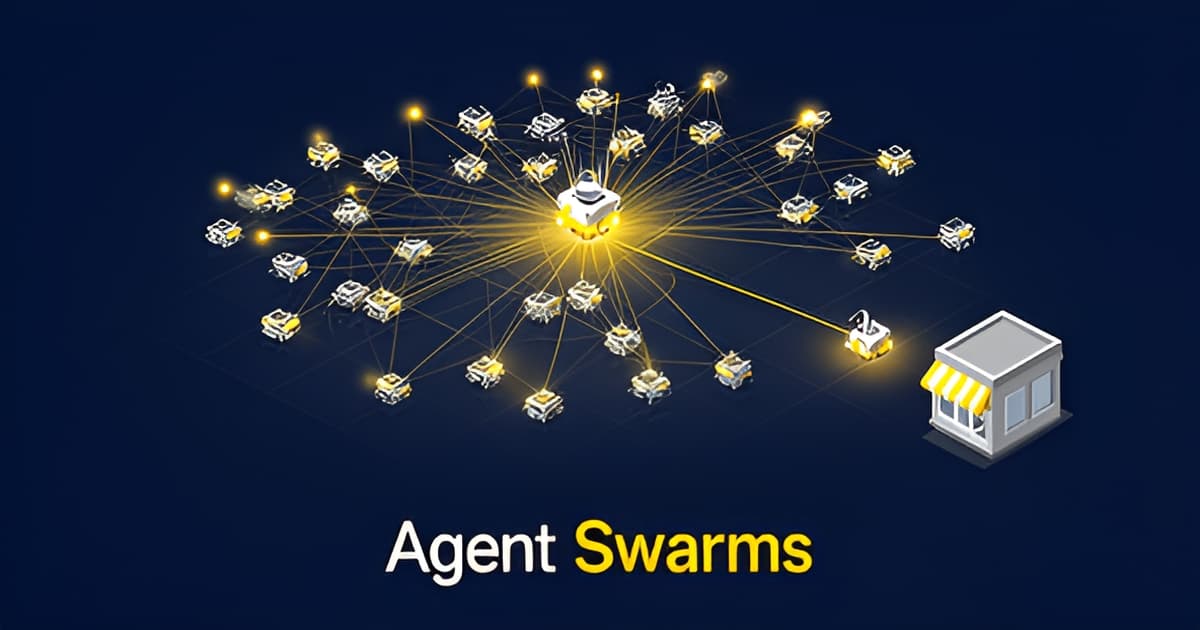
- The defining shift is from automating individual tasks (Industry 4.0) to orchestrating agent swarms that execute whole missions (Industry 5.0).
- No-code and low-code platforms mean small firms can adopt agents without an engineering team, though someone still has to design, connect, and operate them.
- Manufacturing faces a projected 3.8 million worker shortfall by 2033, and AI is being positioned as a way to compress training and augment existing staff rather than replace them.
The core idea Google's team laid out is a change in philosophy. Industry 4.0 was about automating individual tasks with high precision: one machine, one job, repeat forever. Industry 5.0 flips the frame. Instead of asking "which task can we automate?" the question becomes "which mission can a group of agents execute end to end?" The deployments back this up. Briggs & Stratton runs 25 agents that handle change management, orchestrate operations, and answer procedural questions for staff. Honeywell's agents take on designing, proposal writing, and project management, compressing work that used to take six weeks down to four days. GE Appliances has released roughly 800 manufacturing agents under its Brilliant Factory initiative, letting workers pull real-time operational and quality information through a mobile app, and its automated supply chain work contributed to a 25% reduction in back orders. Honeywell's reported numbers include $200 million in savings and a 40-60% reduction in time-to-market. Notice what these agents are doing. None of them is a single clever trick. Each one handles a slice of a mission, and the value comes from coordination across the slices. That's the structural change, and it's the part worth watching if you're a smaller operator.
The most relevant detail for small and mid-size businesses is how these agents get built. Google positions Gemini Enterprise as a no-code/low-code environment and has been explicit that smaller manufacturers shouldn't need "an army of engineers" to deploy agents. Google's Open Knowledge Format, an open-source standard for how data gets formatted for AI, is aimed at the same problem: making enterprise data legible to agents regardless of vendor. Here's the honest caveat, though. No-code means you don't write code. It doesn't mean the agent designs itself. Somebody still has to decide what the agent is for, connect it to the tools the business already runs, define when it escalates to a human, and keep it working as the business changes. That's why the done-for-you model exists at all. Large manufacturers hire integration teams for this. A plumbing company, a law office, or a two-person insurance agency doesn't have that option, and shouldn't need it. The gap between "the platform makes it possible" and "the agent actually runs your front desk" is where most small-business AI projects stall.
Manufacturing is staring at a projected shortfall of 3.8 million jobs by 2033, according to industry estimates cited in the report. Google's argument is that AI can compress training timelines that currently run 7-10 years by converting standard operating procedures into AI coaches and instructional videos, effectively raising what a generalist can handle with AI support. They call it democratizing expertise and creating "citizen agents." This maps almost exactly onto what small businesses already experience, just without the industry statistics. The owner who answers every call personally, the office manager chasing leads between tasks, the technician who's also the quote-writer: that's a skills and capacity gap, not a headcount problem you can solve by hiring in a tight labor market. Agents that answer phones, follow up on leads, and handle routine support don't replace those people. They take the volume the team is currently missing. Missed calls don't get converted by anyone. Slow follow-up doesn't close itself.
It's worth noting this isn't a manufacturing-only trend. The Cipher Brief reports the CIA ran more than 300 AI projects in 2025 and used AI to generate an intelligence report for the first time, with Deputy Director Michael Ellis describing the shift toward "AI coworkers" embedded in analytic platforms. Stanford's 2026 AI Index shows frontier models gaining 30 percentage points on expert exams in a single year, and benchmarks like ForecastBench show AI reaching statistical parity with human superforecasters on real-world prediction tasks. When intelligence analysts and factory supervisors are adopting the same underlying architecture, agent swarms with natural language interfaces and human oversight, you're looking at a horizontal layer of enterprise software, not a niche tool. The pattern is consistent across both worlds: AI drafts, triages, flags, and executes, while humans keep judgment calls and escalation paths.
There are two practical lessons in these reports for an owner-operator. First, think in missions, not tasks. A single agent that answers the phone is useful. An agent that answers the phone, logs the call into your CRM, books the appointment, and hands off to a follow-up agent that nurtures the lead is a mission. The enterprise deployments prove the coordinated version is where the returns are, and the same composition works at small scale. The technology that coordinates a factory floor can coordinate a front desk. Second, insist on human-in-the-loop boundaries. One of the more mature examples in the report comes from Augury, whose industrial profile lets operators define the conditions for an alert and has the AI validate those conditions to filter noise before anything reaches a person. That principle applies directly to customer-facing agents. Your AI receptionist should have clear rules for when it handles a conversation itself and when it hands off to you, and those rules should be explicit, not emergent. Any agent you deploy should have that architecture, and you should ask for it by name.
The headline numbers from IMTS 2026, $200 million saved, 800 agents deployed, six weeks of work done in four days, belong to giants. The architecture behind them doesn't. Agent swarms are becoming the standard way businesses of every size coordinate work, and the platforms are accessible enough that the barrier is no longer technology. It's design and operation: knowing which missions to hand over, connecting the agent to what you already use, and setting the boundaries where a human stays in the loop. That's solvable work, and it's the difference between reading about Industry 5.0 and quietly running your own version of it from a two-line office. If you want to scope what a first agent could handle for your business, book a call and we'll sketch it out with you.