
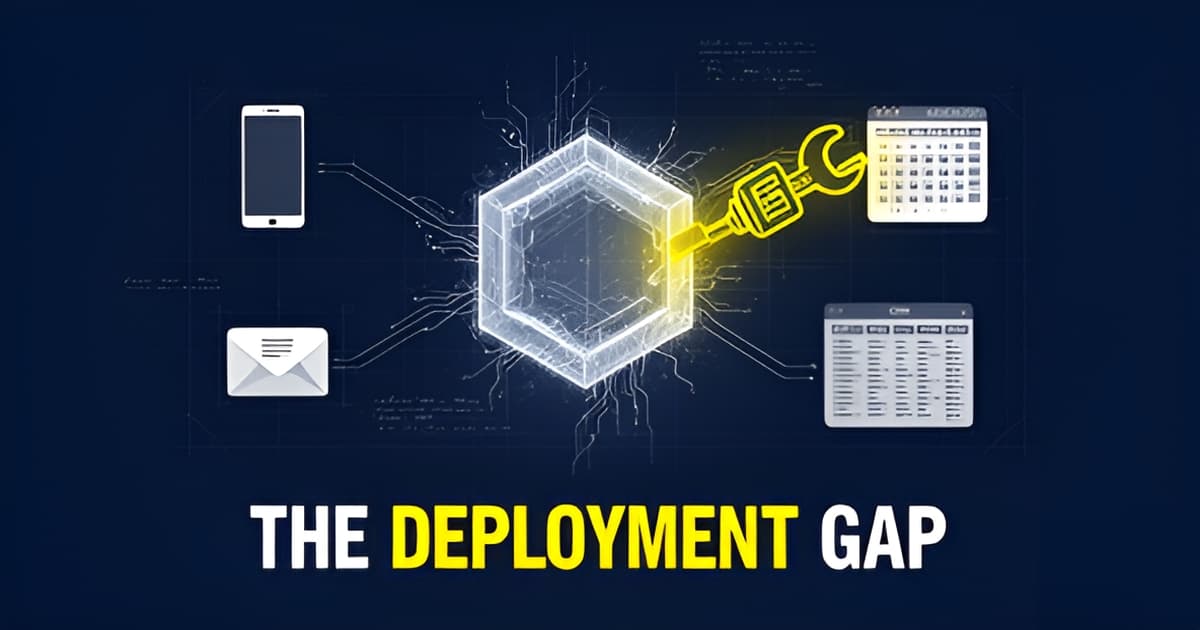
When a multi-billion-dollar software vendor changes how it delivers product, it's worth paying attention. Pegasystems, the workflow automation company best known in banking and insurance, held its Q3 2026 earnings call on October 21 and announced a structural shift: a new go-to-market organization, unified marketing, a smaller headcount, and, most interestingly, a dedicated team of forward-deployed engineers whose job is to get agentic workflows running inside customer operations. That last item is the signal. Pega sells some of the most sophisticated agent software on the market, and it has concluded that its customers still can't operationalize it without hands-on help. If that's true at the enterprise level, it's doubly true for a 15-person plumbing company or a two-partner law firm. The lesson applies at every scale: buying or building an AI agent is one thing. Having it answer your phone, follow up on leads, and book appointments reliably every day is another thing entirely.
Key points
- Pegasystems grew Pega Cloud ACV 20% year over year to $976M, but total ACV growth of 7% fell short of its original plan as enterprise sales cycles lengthened.
- Management is standing up a forward-deployed engineering team specifically to accelerate deployment of agentic workflows for customers.
- COO Ken Stillwell noted that reorganizations and workforce reductions inside customer companies are pushing out implementation timelines.
- The pattern repeats at every company size: the hard part of AI agents is wiring them into real systems and running them, not designing them.
- Small businesses face the same deployment gap with fewer resources, which is why done-for-you agent builds are becoming the default buying model outside the enterprise.
The headline results were mixed. Total revenue came in at $393.4 million, up 3% year over year, and non-GAAP EPS of $0.35 beat the prior year's $0.30. But the quarter missed Street estimates, and the stock fell in premarket trading, closing the referenced session down roughly 2.9%. Beneath the top line, the mix tells a clearer story. Pega Cloud ACV grew 20% to $976 million and now accounts for 59% of total contract value. Total backlog rose 15% in constant currency to $2.01 billion, with cloud backlog up 25%. Meanwhile, the legacy business is shrinking: subscription license ACV fell 6%, maintenance ACV dropped 12%, and consulting revenue declined 18% as delivery models shift. The problem is new business. Net new ACV for the quarter was $32 million, which management called the strongest quarter of the year, but nine-month net new ACV of $52 million against a $1.66 billion ACV base means the original full-year plan won't be met. Management guided to 7-10% ACV growth for 2026 while acknowledging the shortfall.
Management was explicit about where they think the problem sits. CEO Alan Trefler and COO Ken Stillwell framed the shortfall as an execution issue: enterprise deals now involve more stakeholders, more approval layers, and more scrutiny of large technology purchases, particularly in financial services. Stillwell added an observation that deserves more attention than it got. Reorganizations and workforce reductions inside customer organizations are pushing out implementation timelines for new technology projects. Read that twice. Companies adopting AI to reduce headcount are, in the near term, creating internal churn that delays the very software projects meant to enable that automation. It's a second-order effect of the AI adoption wave that few vendors are talking about publicly. Pega's structural response includes the forward-deployed engineer team, a delivery model popularized by Palantir and now standard across enterprise AI. The reasoning is simple: selling agents is not enough. Customers need people who will sit inside the business, wire the agent into existing systems, and run it until it works.
You might reasonably ask what a $1.66 billion enterprise software backlog has to do with your business. More than you'd think. The deployment gap Pega is solving with engineers on site shows up in miniature at the SMB level. An owner-operator who buys an AI receptionist doesn't fail because the voice model is weak. The model is fine. The project stalls because nobody connects the agent to the phone system, the CRM, the calendar, and the inbox. Nobody tunes the follow-up sequences. Nobody watches it after go-live. Without an IT department, that work lands on the owner, who is already doing three jobs. This is why the done-for-you model is winning outside the enterprise. The equivalent of Pega's forward-deployed engineers, at small-business scale, is a partner who designs the agent for your specific workflow, integrates it with the tools you already use, and operates it month to month. You own everything, including the phone number and the data, but you don't have to become an AI operator to benefit from one.
One caution on drawing the wrong lesson from Pega's quarter. Its problems, multi-stakeholder procurement, six-figure contracts, compliance review in regulated industries, are the opposite of yours. A small business doesn't have a procurement committee. It has an owner who can make a decision on a Tuesday. That speed is a real advantage, but only if the engagement is structured to use it. A project scoped to one workflow, say, missed calls after hours, or slow follow-up on web leads, can go from decision to live agent in weeks. Compare that to the enterprise pattern Pega described: budget cycles, approval layers, and client-side reorganizations stretching implementations across quarters. The practical takeaway: scope small, move fast, and don't sign up to run the technology yourself. The businesses seeing value from agents in 2026 aren't the ones with the biggest AI budgets. They're the ones that picked one expensive workflow, had it handled, and moved on to the next.
Pega's numbers also confirm a shift in how businesses want to pay for software. Cloud ACV up 20%, cloud backlog up 25%, maintenance ACV down 12%. Buyers are voting for consumption and subscription models over license-plus-maintenance, and they're consolidating spend with vendors who deliver outcomes rather than toolkits. The SMB translation is straightforward. The old model was: buy software, figure it out yourself, hope someone on staff maintains it. The emerging model is: have the workflow handled. For agents specifically, that means paying for answered calls and booked appointments rather than for a platform you have to configure. It also means the market has moved past the demo stage. Agentic workflows are a budget line item now, embedded in claims handling, onboarding, servicing, and, at the small-business layer, on the phone line and in the inbox. The vendors and partners who win will be the ones who can operationalize, since that, as Pega just demonstrated with its own reorganization, is where the market says the work actually is.
Pega's Q3 is a useful datapoint for anyone deciding how to bring AI agents into their business. A company with thousands of enterprise customers just restructured itself around one insight: agents don't deliver value until someone deploys them, integrates them, and runs them. Small businesses face the same reality with a fraction of the resources, which makes the delivery question more important, not less. If you're evaluating an AI agent for your phone line, your follow-up, or your scheduling, the question worth asking any vendor is simple: who runs this after it's built? The answer matters more than the demo.