
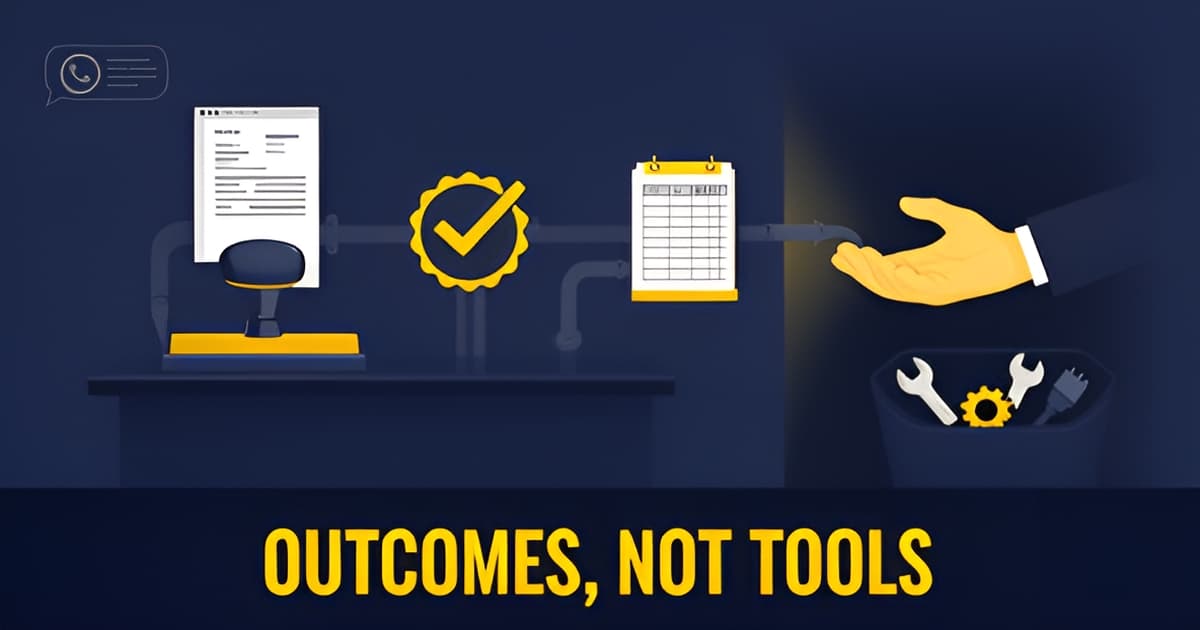
If you run a small business, two pieces of news from this past week deserve your attention, and neither is about a flashy new model. The first comes from Costa Rica, where cloud accounting platform Alegra launched Alegra Bot, an AI agent built directly into the accounting workflows its users already run. The second comes from the US, where TechEsperto announced a structured migration program to move small and mid-sized businesses off per-user Salesforce licensing onto the open-source SuiteCRM platform. Different industries, different geographies, same underlying story: businesses are tired of buying tools they have to assemble themselves. They want outcomes, and they're increasingly willing to pay specialists to deliver them.
Key points
- Alegra launched Alegra Bot in Costa Rica, an AI accounting agent embedded directly into daily workflows, with vendor-reported savings of 6.1 hours per week on automated accounting tasks.
- Alegra's tax filings require human confirmation before submission, showing that human-in-the-loop controls are becoming a design standard for regulated work.
- TechEsperto announced a seven-stage Salesforce-to-SuiteCRM migration program for US SMBs, built around escaping per-user licensing costs without disrupting sales operations.
- Both stories point to the same shift: customers want the managed transition and the result, not the assembly work.
- Channel-native delivery matters; Alegra meets users on WhatsApp, browser, and mobile, mirroring how local businesses need agents that work where their customers already are.
Alegra Bot is a useful case study in how AI agents have matured. Rather than pointing an external chatbot at a company's data, Alegra embedded the agent into the daily work of accounting. Users can ask questions in plain language about sales, expenses, bank reconciliations, and profit and loss, then export results to Excel or PDF, receive them by email, or interact through WhatsApp, a browser, or mobile apps. The agent also handles Costa Rican compliance specifics natively, including v4.4 electronic receipts, CAByS codes, and D-150 tax forms. Alegra's product head, David Sánchez, framed the shift as moving accounting software away from being a static archive and toward information that arrives proactively, with context attached. That framing matters because it reflects a real complaint from practitioners: accountants spend a large share of their month compiling raw data before any analysis happens. Costa Rica's professional body, the CCPCR, counts more than 7,000 active CPAs and 130 registered firms, and most of them know that repetitive monthly reporting grind firsthand. The platform reports that its automated accounting workflows save users an average of 6.1 hours per week. That's a vendor-supplied figure, so treat it accordingly, but it's a concrete number attached to a specific task set, which is more than most AI vendors offer. There's a technical backstory worth knowing too. Before building its own agent, Alegra set up an MCP (Model Context Protocol) server in Costa Rica, the first accounting platform in Latin America to adopt that standard, letting external assistants like Claude and ChatGPT connect to user data. Alegra Bot is effectively phase two: after proving the connection layer, the company brought the AI in-house and embedded it where the work actually happens.
The second story is about CRM costs, and it hits a nerve that most growing businesses recognize. TechEsperto's program, announced November 9, helps US SMBs move from Salesforce to SuiteCRM, an open-source alternative with no per-user license fees, full data ownership, self-hosting options, and code-level customization that doesn't require vendor approval. Here's the interesting part. According to TechEsperto's own positioning, most of these businesses aren't unhappy with Salesforce's features. They're unhappy with the bill. Seat-based pricing, add-ons, and renewal cycles turn the CRM into a major line item as the team grows. The destination platform is rarely the hard part. The hard part is the move itself: years of records, Apex triggers, Process Builder flows, reports, and integrations don't transfer automatically, and a badly planned migration can stall a sales pipeline for weeks. That's why the program is structured as a seven-stage process: discovery and planning, SuiteCRM setup, ordered data migration (accounts, then contacts, then opportunities, then activities, then cases, preserving relationships), workflow and automation rebuilds, testing, role-based training on the client's own data, and a 30-day hypercare period after go-live. TechEsperto's CEO, Arinder Singh Suri, described the goal as making the switch predictable so teams keep their data and workflows while cutting costs. Notice what's actually being sold here. Nobody is buying SuiteCRM the software. They're buying a managed transition with a defined process, a validation phase, and someone accountable for the first 30 days. The migration is the product.
One design decision in Alegra Bot stands out for any business considering agents in regulated or high-stakes work: tax submissions to Hacienda, Costa Rica's Ministry of Finance, require explicit user confirmation before the agent files anything. The agent does the preparation; a human approves the submission. That's the right pattern, and it's increasingly the pattern buyers should demand. In accounting, legal work, healthcare, and insurance, an agent that can't show where the human checkpoint sits is an agent you can't safely deploy. Alegra treating confirmation as a feature rather than a limitation is a signal of where agent design is heading for compliance-sensitive industries. If you're evaluating agents for your own business, ask every vendor the same question: what does this agent do on its own, and where do I sign off?
Put the two stories side by side and a few practical lessons emerge for owner-operators. First, embedded beats bolted-on. An agent that lives inside your existing workflows and tools delivers more value than a standalone assistant you have to remember to open. Alegra's WhatsApp access works because that's where its users already are. For a trades business or a law office, the equivalent is an agent answering a real phone number, following up on leads inside your CRM, or handling email in your actual inbox. Second, cost pressure is driving real behavior change. The seat-price rebellion against per-user SaaS licensing isn't theoretical; structured migration services exist because businesses are actively looking for exits. If your software bill scales faster than your revenue, you have options now that didn't exist a few years ago. Third, time recovery is the honest way to measure automation. Alegra's 6.1 hours per week figure is vendor-reported, but it's the right kind of claim: hours returned on specific recurring tasks. When you evaluate an agent for your business, ask for that kind of specificity. Hours saved on reconciliations, follow-ups, or report compilation is a number you can sanity-check against your own calendar. Fourth, ownership matters. Both stories emphasize it: SuiteCRM buyers keep their data and code; Alegra users keep their financial records in their own accounts. Any agent you deploy should work the same way. You should own the number, the data, and the workflows when the engagement ends.
The common thread between an accounting agent in San José and a CRM migration program in the US is that businesses have stopped being impressed by AI in the abstract. They want the phone answered, the follow-up sent, the report compiled, the migration completed without a stalled pipeline. That's a healthy development. It shifts the conversation from what the technology can do to what your team stops doing, and it rewards vendors who take responsibility for the outcome instead of handing you a toolkit. Whether you're looking at agents for reception, sales follow-up, support, or back-office workflows, the evaluation criteria are getting simpler: where does it live, where's your checkpoint, who's accountable, and what do you own at the end. Ask those questions and you'll filter out most of the noise.