
For the past two years, most business conversations about AI have been about software doing work for people. A chatbot answers questions. A writing assistant drafts emails. That frame is already out of date. The newer question, showing up in executive playbooks and platform roadmaps across 2026, is what happens when software starts doing work for other software. AI agents that browse, negotiate, transact, and delegate to other agents. Researchers have started calling it the agent-to-agent economy, and while the phrase sounds like something reserved for Fortune 500 boardrooms, the mechanics behind it are showing up in businesses with five employees and a shared inbox. If you run a plumbing company, a law practice, or an insurance agency, you probably have no plans to build autonomous procurement systems. That's fine. The useful part of this trend for you is smaller and more immediate: agents that hand work to each other inside your business, and eventually agents that can do business with agents outside it. Here's what's actually happening and what it means for a company your size.
Key points
- The agent-to-agent economy means AI software acting as a buyer and employer of other software, handling procurement, delegation, and payment autonomously.
- Interoperability standards and agentic commerce pilots from major payment networks and retailers have moved this from theory to active testing since 2024.
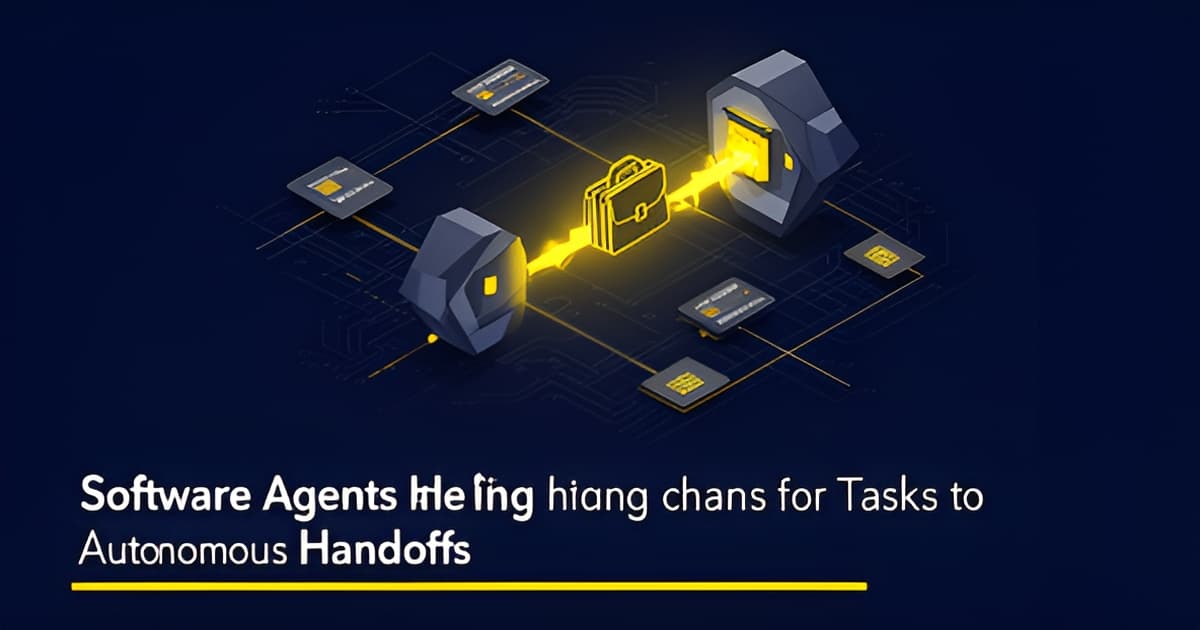
- For small businesses, the practical version is multi-agent handoffs: a receptionist agent passing a lead to a follow-up agent, which passes it to an appointment setter.
- Owner-operators in trades, legal, healthcare, and real estate will not build these workflows themselves; done-for-you agent operation is the realistic entry point.
- Governance matters: when agents transact on your behalf, you need clear ownership of the agents, the data, and the work product, which favors month-to-month arrangements where you keep everything.
Strip away the futurism and the agent-to-agent economy describes a simple shift. Today, when your business buys something, a person compares options, negotiates, and clicks the button. In an agent economy, an AI agent does that on your behalf, and the vendor on the other end may also be an agent rather than a sales team. The building blocks have been assembling for a while. Since 2024, major platform vendors have pushed interoperability standards so agents can discover each other and communicate without custom integration work for every pairing. Payment networks and large retailers have run pilots where AI shopping agents browse and purchase on behalf of users. None of this is hypothetical anymore; it's in testing and early deployment. The executive-level framing you'll see in playbooks talks about autonomous procurement, machine-readable service catalogs, and algorithmic corporate wallets. That's the enterprise version. The small business version looks less like a robot CFO and more like your scheduling agent checking another agent's calendar and booking a slot without anyone touching a keyboard.
Most small businesses don't need agents that transact with the outside world yet. What they need first is agents that cooperate internally, because that's where the daily friction lives. Consider a common scenario. A homeowner calls a contractor at 6:40 on a Tuesday evening. Nobody answers. In the old model, that's a missed call and probably a lost job, since most callers won't leave a voicemail and most won't call back. In a multi-agent setup, an AI receptionist answers on a real phone number, qualifies the call, and hands the details to a follow-up agent that sends a text and books an estimate. The appointment lands on the calendar. The owner finds out the next morning, with the job already scheduled. That chain, receptionist to follow-up to appointment setter, is a modest version of agent-to-agent work. Each agent does one job well and passes the baton. The reason this matters now is that the same design pattern scales. When agents outside your business become able to request quotes, book services, and exchange payment details machine-to-machine, the businesses whose agents already talk to each other internally will be the ones ready to participate. The ones still relying on a phone that rings into the void won't be.
There's no shortage of DIY agent toolkits on the market. They're aimed at people who enjoy wiring APIs together on weekends. If that's you, great. If you're an electrician, a family-law attorney, or a real estate agent, your time is better spent on billable work than on maintaining integrations between your phone system, CRM, and calendar. The realistic path for a small team is a done-for-you arrangement: a studio designs the agents for your specific workflow, connects them to the tools you already use, and keeps them running. You describe how jobs flow through your business; the operator handles the plumbing. Month-to-month terms matter here too, because you shouldn't have to sign a multi-year contract to find out whether an agent setup fits your operation. This is also where the agent economy's governance questions become concrete. When an agent books a job or sends a follow-up on your behalf, who owns that agent, the data it collects, and the customer relationships it touches? The sensible answer is that you do, fully, and that any arrangement where the vendor holds your workflow hostage to lock-in is a bad trade at any price.
When one agent hires another, someone still owns the outcome. That's the uncomfortable part of the agent economy that executive playbooks spend the most time on, and it applies at every scale. If your scheduling agent double-books a Tuesday, the customer doesn't blame the software. They blame you. This is why agent deployments need clear design, monitoring, and a human who can intervene. An agent answering your phone should sound like your business, follow your rules for what gets promised, and escalate anything outside its lane to a person. It's also why the 'who designed it and who runs it' question matters as much as the technology. An agent built generically for a thousand businesses will handle your edge cases poorly. An agent designed around how your company actually operates, and adjusted when those operations change, behaves like part of the team rather than a bolted-on gadget.
You don't need to prepare for a fully autonomous procurement future this quarter. A short, practical list is enough: First, find your biggest leak. For most service businesses it's missed calls or slow lead follow-up, and that's where an agent pays for itself fastest. Second, favor agents that integrate with what you already run. Your calendar, your CRM, your phone number. Replacing your entire stack to adopt AI is a project nobody with a small team should take on. Third, insist on ownership. Whatever agents you deploy, the data and the workflows should be yours, and the arrangement should be one you can exit monthly. Fourth, keep a human in the loop where it counts. Agents are good at first response, qualification, and follow-through. Final judgment on pricing, promises, and edge cases stays with you.
The agent-to-agent economy is arriving in stages, and the stage that matters to a small business is already here: agents that answer, follow up, schedule, and hand work to each other without waiting for a person to click anything. The enterprise-level version, where software hires software across company boundaries, will build on the same foundations. Businesses that get their internal agent workflows working now will plug into that future when it arrives. Businesses that don't will be the ones whose phones ring unanswered while their competitors' agents are already booking the job. The gap between those two outcomes isn't technology budgets. It's a decision about who handles the busywork, and it's one worth making while the advantage is still available.